
Inversion (geobrain.inverse, geobrain.optim)#
geobrain.inverse states the problem; geobrain.optim searches it.
Stating the problem#
# sketch: runnable version in the quick start
InverseProblem(forward=..., observed=..., likelihood=..., prior=...)
Piece |
Options |
|---|---|
Likelihood |
|
Prior |
|
Waveform misfits |
|
Filtering |
|
Joint |
|
The waveform misfits are not interchangeable. Least squares is the one that falls into a local minimum when the starting model is a cycle out; envelope, travel-time and Wasserstein misfits are the ones that do not, and a multi-scale schedule usually starts with one of those.
Searching it#
Inverter is the loop; AdamConfig and LBFGSConfig choose the optimizer.
Piece |
Options |
|---|---|
Regularizers |
|
Structural coupling |
|
Weighting |
|
Gradient processing |
|
Bookkeeping |
|
A regularizer is a prior seen from the other side
A smoothness term in the objective is a Gaussian prior on the model’s
roughness. Writing it as a prior= on the problem rather than as a term in the
loss means the Bayesian door sees it too, automatically, and without a second
copy that can drift out of step.
Where your geology goes#
Regularization is not a numerical detail; it is where you say what you believe
about the earth before the data arrive. Smoothness says gradational contacts.
Total variation says blocky units with sharp boundaries. cross_gradient says
two properties change where together but not how much together, which is
what you want when the physics are independent but the geology is not.
gmm_prior says the cells belong to a known set of rock types, which is the
strongest statement of the four and the one that turns two property images into
a rock-unit map.
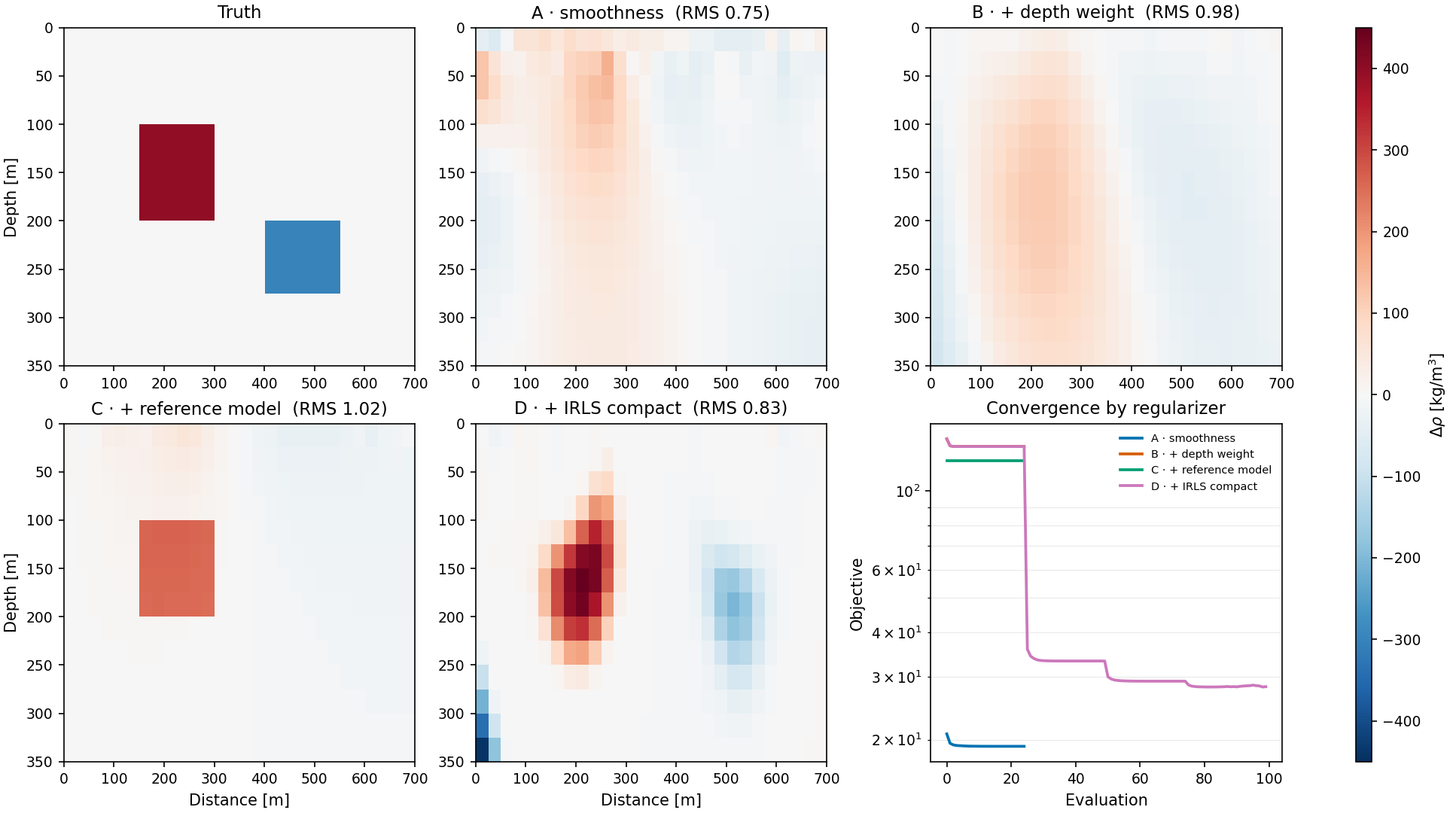
The knobs this page describes, and what each one buys: regularizers, bounds
and an IRLS sparsity pass. From
examples/01_architecture/05_inversion_toolbox.py.#
Stopping#
Data carry noise. Driving the misfit to zero fits the noise and grows structure to do it, so the honest stopping rule is chi-squared, the misfit measured in units of the noise, reaching 1. The physics examples stop there and show what carrying on looks like.
See also#
examples/01_architecture/05_inversion_toolbox.py: regularizers, bounds and IRLS, compared on one problem.examples/03_physics/02_dc_resistivity.py: the stopping rule, and what happens past it.examples/03_physics/04_petrophysical_joint_inversion.py:gmm_prioras the coupling that gives a rock-unit map.