
Wave physics (geobrain.physics.wave)#
Seismic wave propagation, reflectivity, and the wavelets that drive them.
Component |
What is there |
|---|---|
Time domain |
|
Frequency domain |
|
Reflectivity |
|
Wavelets |
|
Surveys |
|
Configuration |
|
A wavelet and a reflectivity kernel. Between them, a convolutional forward model:
import torch
from geobrain.physics.wave import AkiRichards, ricker

wavelet = ricker(64, 0.002, 25.0, dtype=torch.float64)
print("wavelet", tuple(wavelet.shape), "peak at sample", int(wavelet.argmax()))

avo = AkiRichards(angles_deg=[0.0, 15.0, 30.0])
spec = avo.differentiability
print("AkiRichards:", spec.trainable_inputs, "->", spec.output_keys)
wavelet (64,) peak at sample 31
AkiRichards: ('vp', 'vs', 'rho') -> ('reflectivity',)
ricker is zero-phase by default: the peak sits in the middle of the
window, not at its start, and causal=True shifts it if that is what your
recording convention expects.
Note what the kernel asks for: vp, vs and rho. Put it at the end of a
chain that starts from vp alone and the chain’s contract still says vp:
the other two are produced upstream by rock physics, and the chain parameterizes
on its entry link.
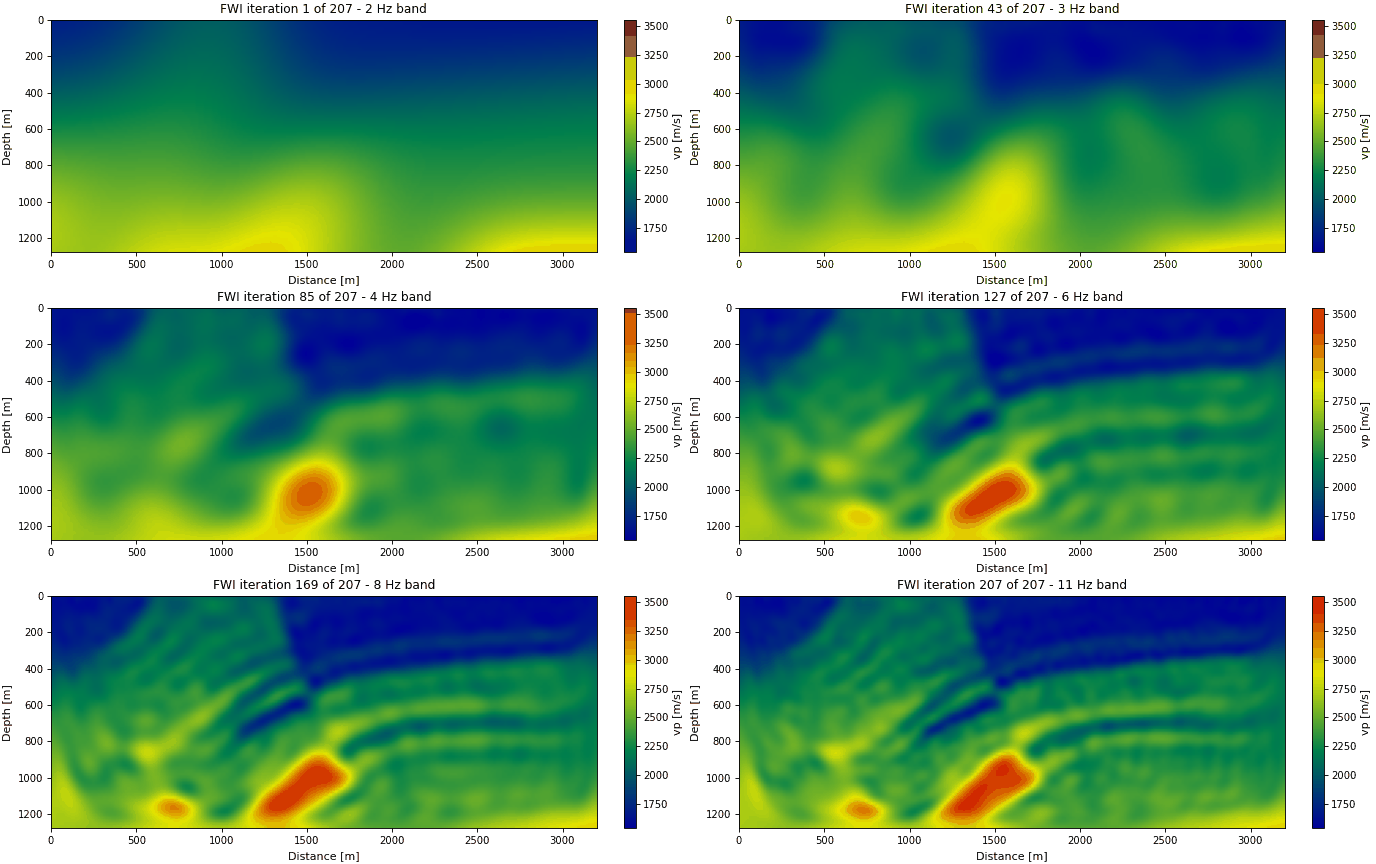
Full-waveform inversion climbing the frequency bands, which is the one place
in the gallery where time is genuinely the subject. From
examples/03_physics/01_seismic_fwi.py.#
The engines#
The time-domain engines take a survey and a wavelet and return a gather. They declare an adjoint rather than taping every timestep, which is what makes FWI on a real model affordable.
Note
Helmholtz2D declares IMPLICIT_VJP: the forward pass solves a linear system,
and the gradient comes from an implicit-function adjoint at the price of one
extra solve, not a tape through the factorisation.
WaveOutputConfig selects what comes back. Ask for the seismic data and you
get the data; asking for wavefield snapshots is a separate, heavier request.
See also#
examples/03_physics/01_seismic_fwi.py: multi-scale FWI on Marmousi II, 2 to 11 Hz.examples/00_showcase/02_operator_composition.py: an acoustic chain and a gravity chain as two channels of one bundle, sharing a rock-physics link.examples/01_architecture/03_composition_rules.py: Aki-Richards as the terminal link, and what the chain derives from it.