
Neural networks (geobrain.nn)#
Not a separate mode, and not a solver. A network here is an operator you
compose in front of the physics with @, which changes what the unknowns
are without touching the forward model.
Piece |
What is there |
|---|---|
Reparameterization |
|
Decoders |
|
Variational layers |
|
KL machinery |
|
Utilities |
|
Three answers to “what are the unknowns?”#
# sketch: runnable version in examples/00_showcase/06
explicit = seismic                                     # the image itself
network  = seismic @ WeightReparameterization(decoder, ...)
latent   = seismic @ LatentReparameterization(decoder, ...)
The unknown is |
The prior is |
|
|---|---|---|
Explicit |
the property image, one number per cell |
none, so wherever the data are weak, the answer is whatever the optimiser drifted into |
Network |
a decoder’s weights, fed a frozen random code |
whatever that architecture can draw. This is the deep image prior |
Latent |
the code, decoder frozen |
the strongest of the three: the image cannot leave the decoder’s range |
All three then go through the same InverseProblem and the same
create_inverter().run(). Not one line of the forward model changes between
them, and the chain reports the switch honestly: ask the network version for
its trainable inputs and it answers with the decoder’s weight names.
What the comparison actually shows#
The unknown count does not order the results
In the worked example the deep image prior wins with the most unknowns, and the latent run beats the explicit one with a fifth of them. The prior is not a term in the objective; it is the set of images the decoder can draw at all.
And the result is a property of that earth, not a law. A convolutional prior is
built for fields that are smooth on the scale the data resolve; where bedding
is finer than the wavelength, the same prior costs resolution instead of buying
it. The claim worth making is narrower and more useful: trying all three cost
three lines and one @ apiece, on the same physics, through the same door.
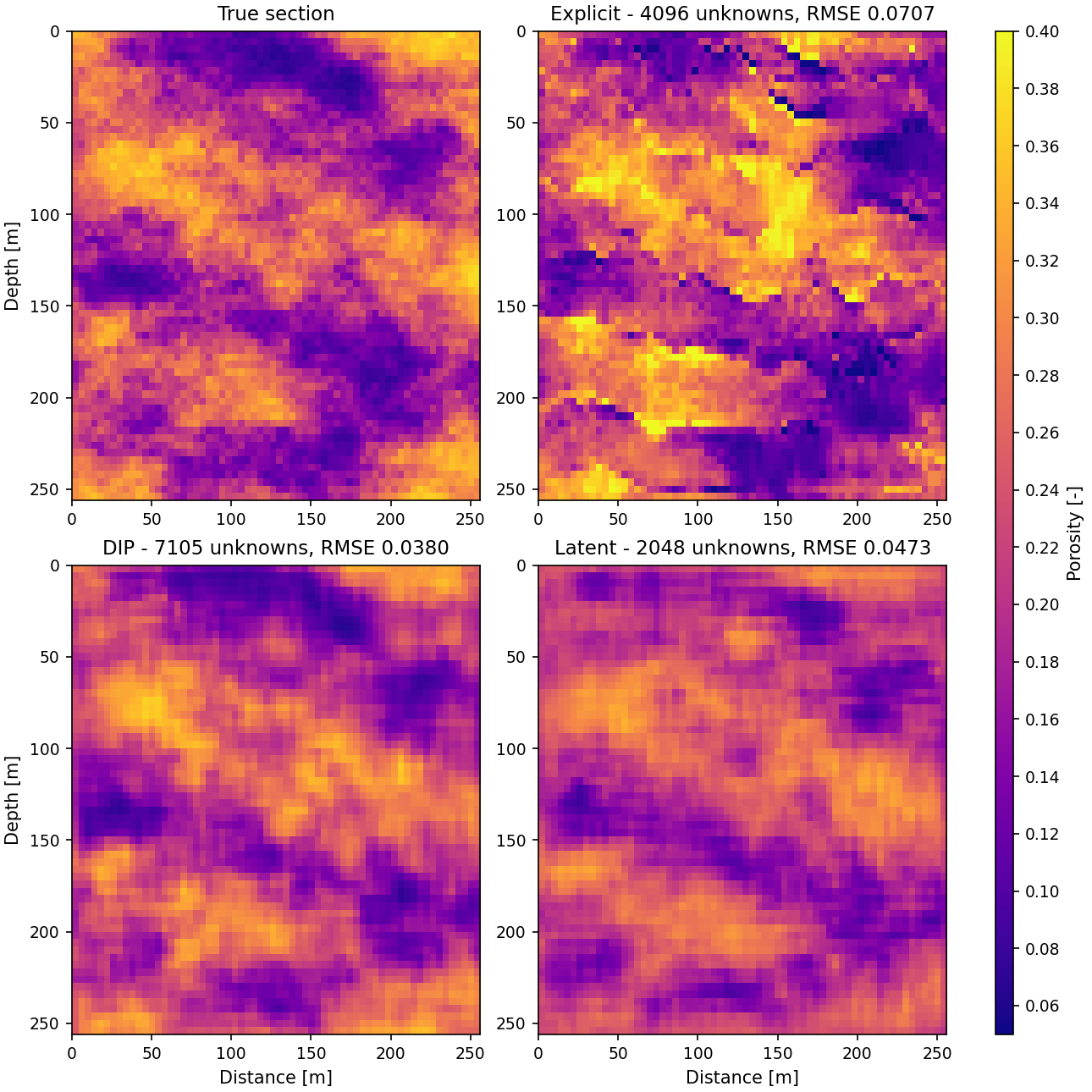
The same inversion run with the unknown as an image, as a decoder’s weights,
and as its latent code. From
examples/00_showcase/06_neural_network_integration.py.#
See also#
examples/00_showcase/06_neural_network_integration.py: all three parameterizations on one seismic problem, scored against the truth.