
Mesh (geobrain.mesh)#
A mesh in GeoBrain carries more than an array shape. It declares what it can support, so physics that needs structure cannot silently be run on something that has none.
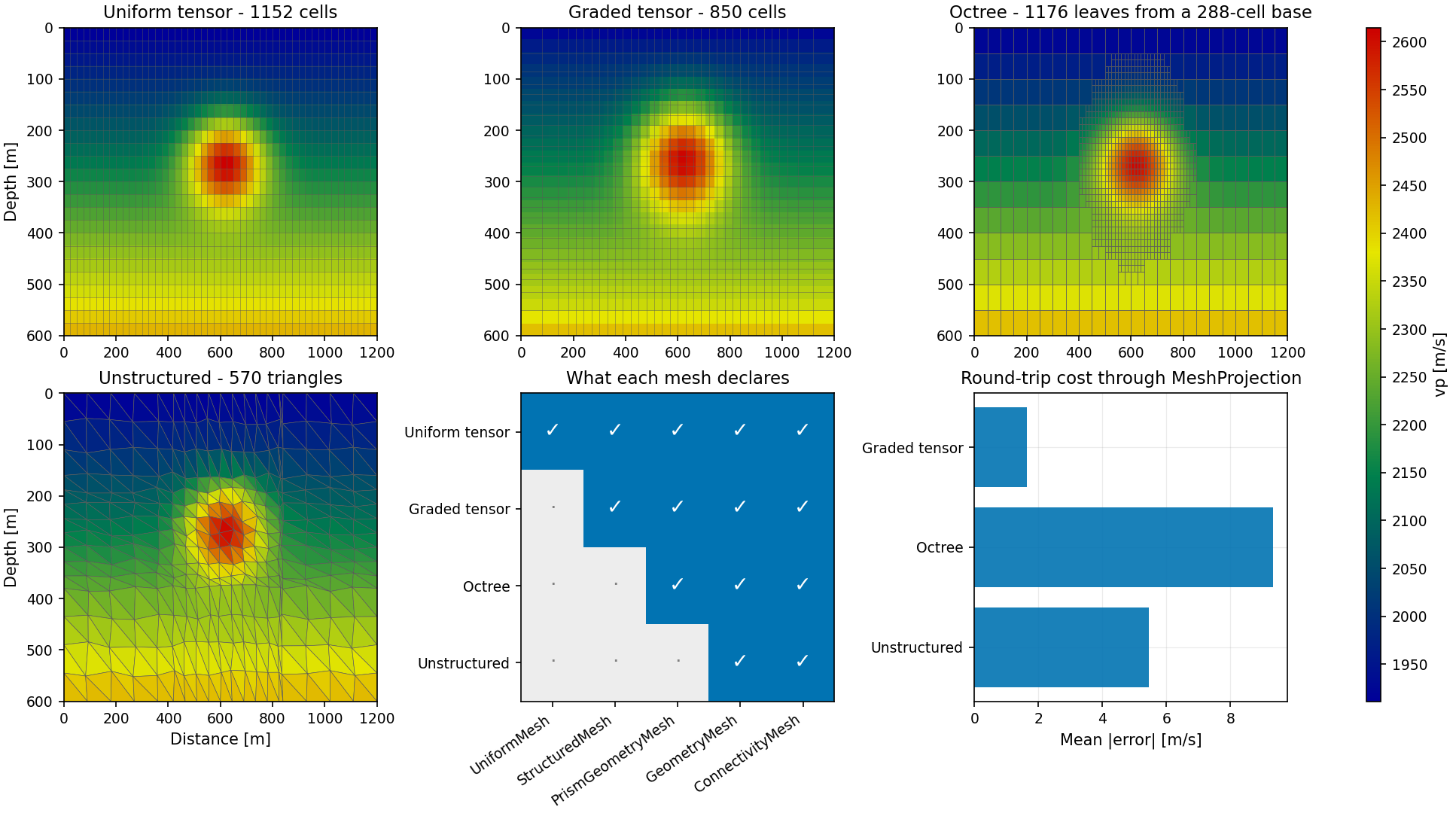
Four discretizations of one domain, each declaring a different set of
capabilities. From examples/01_architecture/02_mesh_taxonomy.py.#
The four you will use#
Class |
Declares |
Used for |
|---|---|---|
|
uniform or per-axis graded cell widths |
finite differences, most physics |
|
refined leaves over a base grid |
local refinement without a global cost |
|
vertices, cells, face connectivity |
geology that does not follow a grid |
|
r-z-θ geometry |
borehole and loop-source problems |
from geobrain.mesh import TensorMesh

mesh = TensorMesh(shape=(24, 48), spacing=(25.0, 25.0))
print(mesh.shape, mesh.n_cells)
(24, 48) 1152
Capabilities are protocols#
Each mesh satisfies a set of named protocols, and each physics declares which it requires:
Protocol |
A mesh that satisfies it can offer |
|---|---|
|
one cell size everywhere |
|
an (i, j, k) index space |
|
cell centres, volumes |
|
rectangular prism corners, what a potential-field kernel integrates over |
|
which cells share a face |
|
edges, for curl operators |
Membership is declared, never inferred from which methods happen to exist, and the platform refuses the structural shortcut outright:
import torch
from geobrain.mesh import (PrismGeometryMesh, StructuredMesh, TensorMesh,
                           UniformMesh)

uniform = TensorMesh(shape=(8, 8), spacing=(10.0, 10.0))
graded = TensorMesh(
    shape=(4, 6),
    cell_widths=(torch.tensor([5.0, 10.0, 20.0, 40.0], dtype=torch.float64),
                 torch.full((6,), 10.0, dtype=torch.float64)))

for name, mesh in (("uniform", uniform), ("graded ", graded)):
    print(f"{name}  structured={mesh.declares(StructuredMesh)}"
          f"  prisms={mesh.declares(PrismGeometryMesh)}"
          f"  uniform={mesh.declares(UniformMesh)}")

try:
    isinstance(uniform, StructuredMesh)
except TypeError as err:
    print("isinstance:", err)
uniform  structured=True  prisms=True  uniform=True
graded   structured=True  prisms=True  uniform=False
isinstance: capability membership is declaration-based: use
mesh.declares(StructuredMesh) or ensure_capable_mesh(...), not isinstance
Two things in that output. Capabilities are refined per instance. The
graded mesh is still structured and still made of prisms, but it is not
uniform, because its cells are not all the same size, and physics that needs a
single dx will be told so. And the structural shortcut is refused:
“it has a cell_centers attribute, so it must be a GeometryMesh” is how a
mesh ends up quietly accepted by physics it cannot actually serve.
require_capable_mesh and ensure_capable_mesh are how an operator states its
requirement, so the error arrives at build time and names what was missing
rather than producing a wrong answer.
Discrete operators#
cell_gradient, face_divergence, edge_curl, boundary_divergence,
average_cell_to_face, average_face_to_cell, harmonic_face_values and
face_transmissibility are the building blocks the PDE physics is written in.
They take a mesh and return sparse operators consistent with that mesh’s
geometry.
Projection between meshes#
MeshProjection maps a field from one mesh to another differentiably, so a
gradient computed on one discretisation returns to the other:
import torch
from geobrain.core import ModelState
from geobrain.mesh import MeshProjection, TensorMesh

coarse = TensorMesh(shape=(6, 12), spacing=(50.0, 50.0))
fine = TensorMesh(shape=(12, 24), spacing=(25.0, 25.0))
project = MeshProjection(coarse, fine, field_name="vp", padding="border")

vp = torch.full((6, 12), 2000.0, dtype=torch.float64, requires_grad=True)
vp_fine, = project(ModelState({"vp": vp})).fetch("vp")
vp_fine.sum().backward()
print(vp_fine.shape, "gradient returned:", vp.grad is not None)
torch.Size([12, 24]) gradient returned: True
A joint inversion can therefore run the wave equation on a structured grid and gravity straight on triangles, and still get one gradient from one backward pass.
Axis convention#
Mesh axes are named in the order the arrays are indexed, and
mesh_axes_to_xyz / xyz_to_mesh_axes convert to and from a right-handed
spatial frame. Getting this wrong transposes the anisotropy into an earth that
still looks plausible, so the conversion is explicit rather than assumed.
See also#
examples/01_architecture/02_mesh_taxonomy.py: four meshes, one domain, and the capability matrix that decides what may run on each.examples/00_showcase/03_mesh_projection_joint_inversion.py: the projection carrying a gradient between two mesh kinds.