
GeoBrain: Differentiable Subsurface Modeling#
Welcome to the documentation of GeoBrain! Here you will find detailed instructions for using the framework. If you want to jump straight to examples, head to the Tutorials section. For the design principles behind GeoBrain, see the Architecture page.
What is GeoBrain?#
GeoBrain is an open, modular, and extensible platform for Geoscientific Bayesian Reasoning with Artificial Intelligence, designed specifically for integrated subsurface modeling.
By combining differentiable physics, Bayesian inference, and deep learning, GeoBrain enables end-to-end workflows for subsurface characterization — from geostatistical modeling and rock physics to geophysical simulation and inversion.

Gallery#
A selection of representative outputs produced by the tutorials included in this package. Each image links to the corresponding tutorial page.
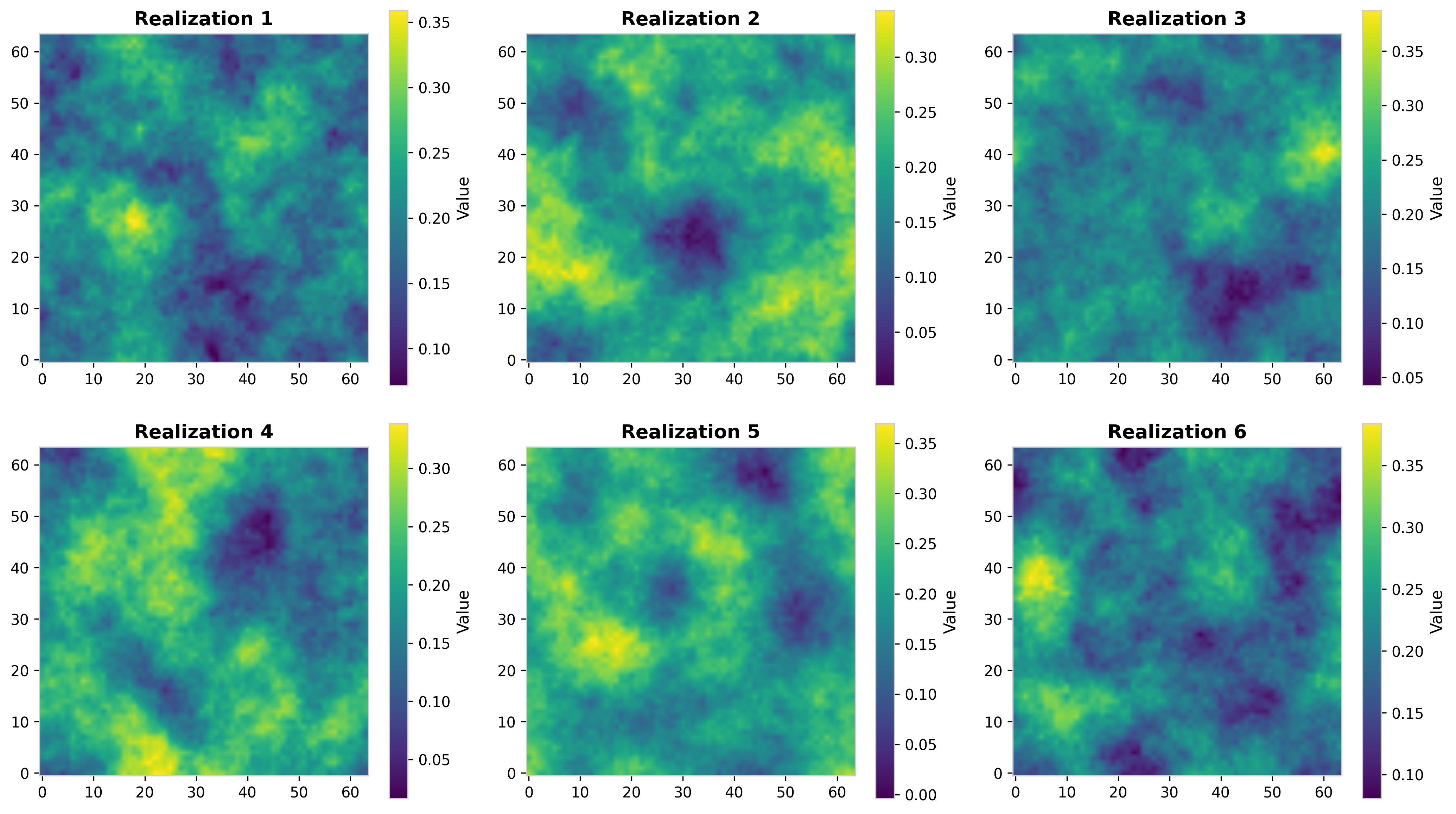
Fig. 1 Geostatistical Simulation – Multiple equiprobable realizations of porosity fields generated with FFT-Moving-Average simulation (Tutorial 01).#
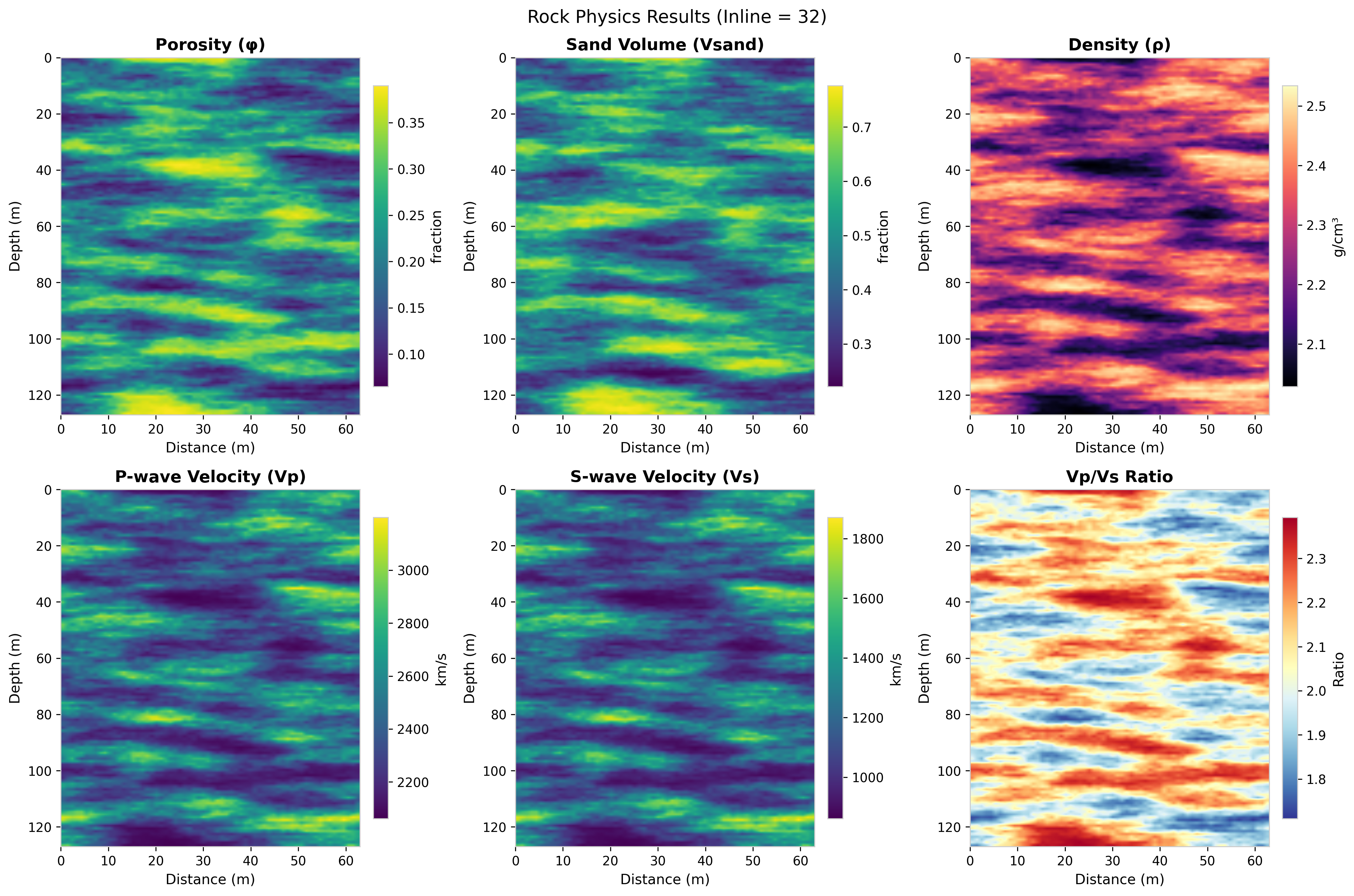
Fig. 2 Rock Physics Modeling – Elastic property fields (P-wave velocity, S-wave velocity, density, impedance) computed from porosity and fluid saturation using differentiable rock physics models (Tutorial 05).#
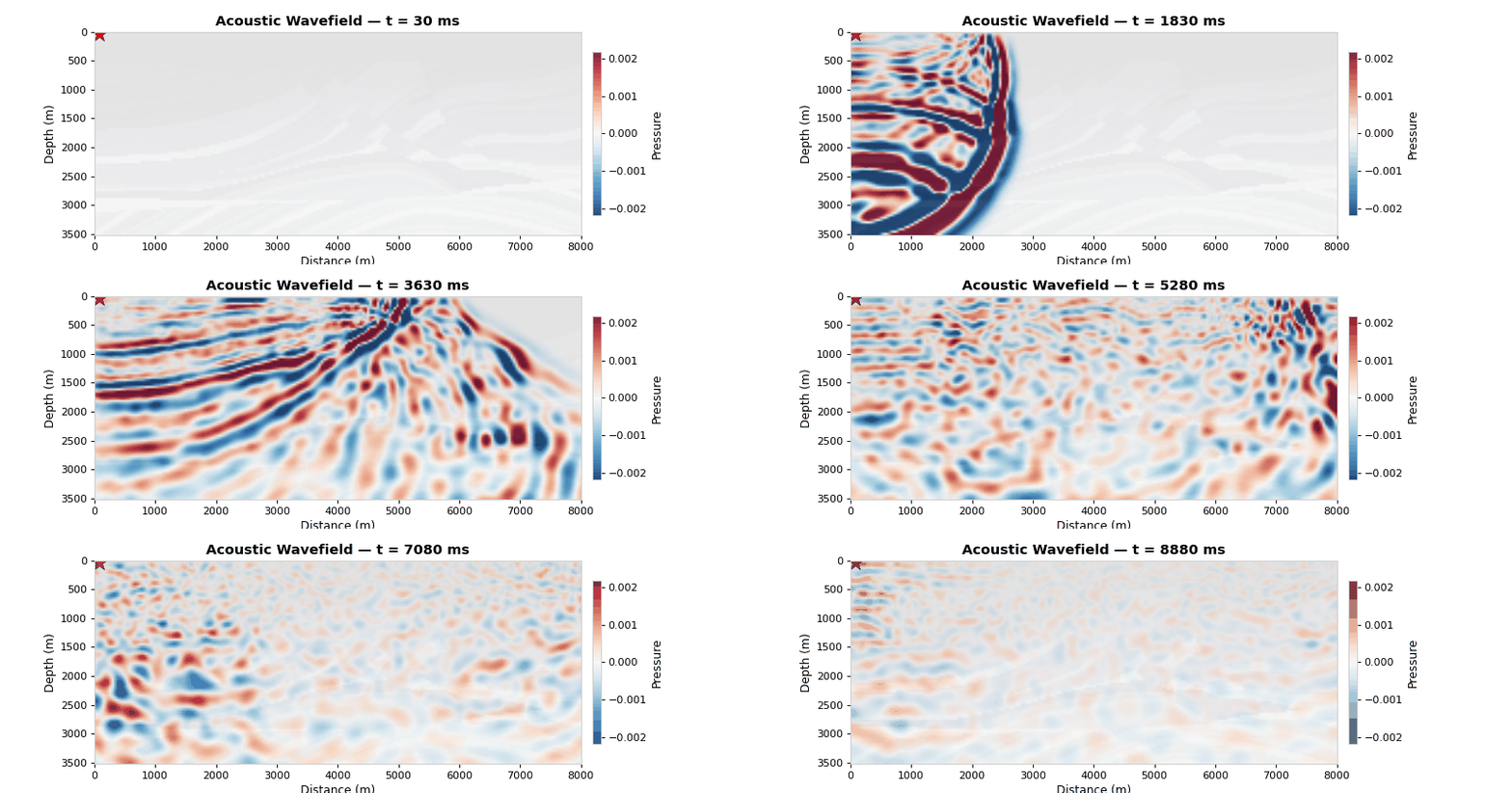
Fig. 3 Acoustic Wave Propagation – Time-domain finite-difference simulation of an acoustic wavefield propagating through the Marmousi2 velocity model (Tutorial 07).#
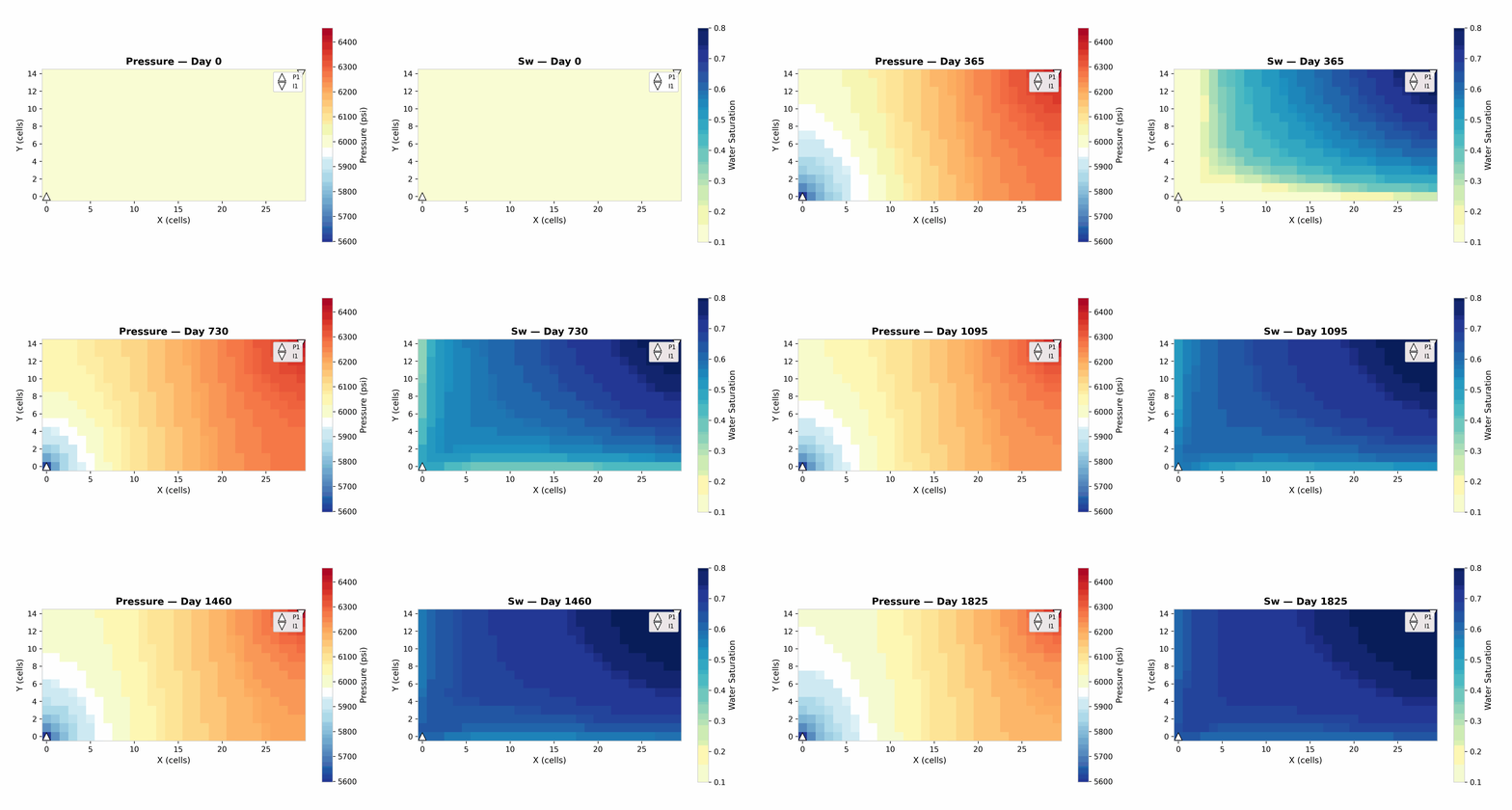
Fig. 4 Reservoir Flow Simulation – Differentiable two-phase (oil–water) flow simulation showing saturation front evolution over time (Tutorial 10).#
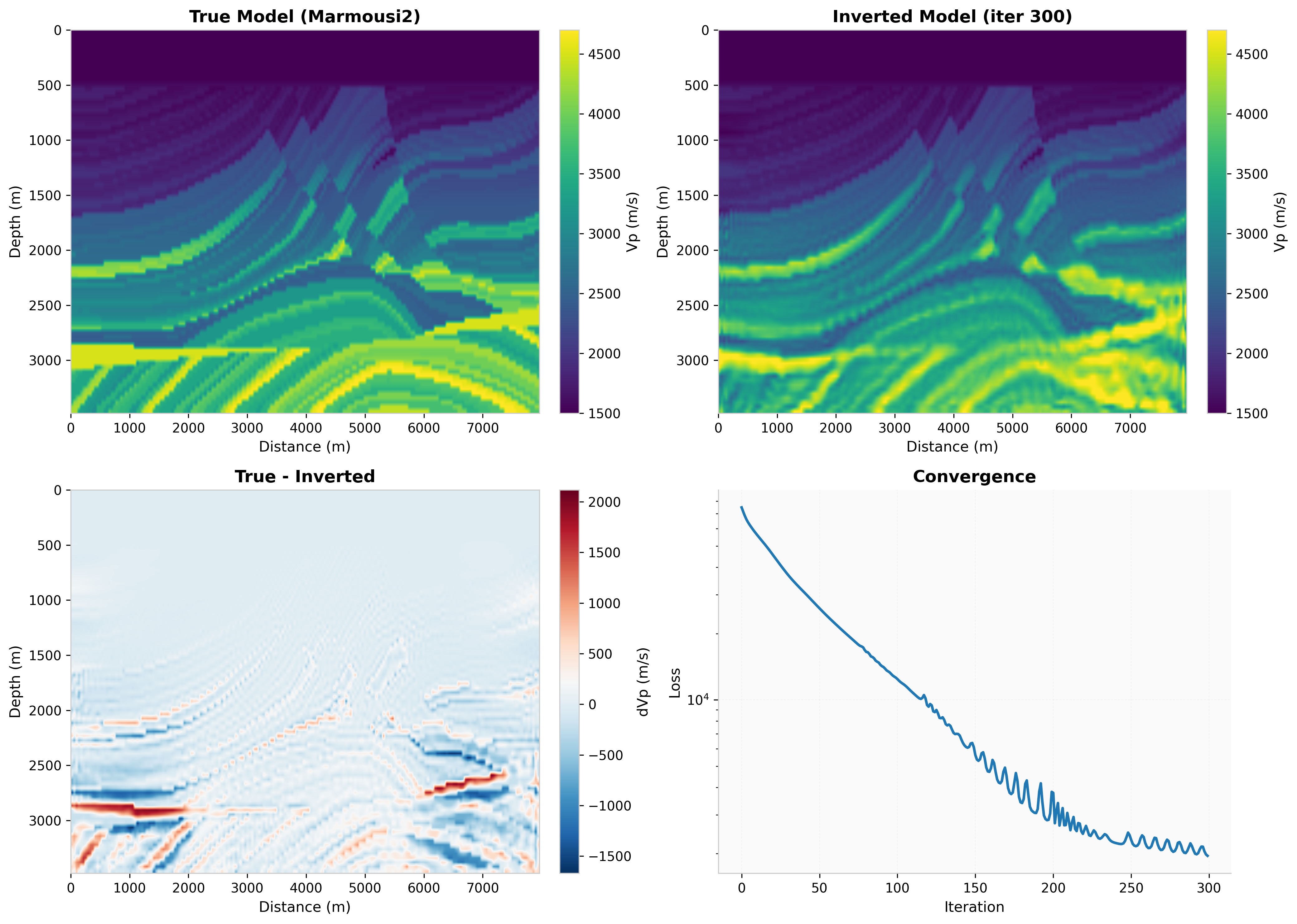
Fig. 5 Full Waveform Inversion – Velocity model recovered by acoustic FWI with PyTorch automatic differentiation, compared against the true Marmousi2 model (Tutorial 09).#
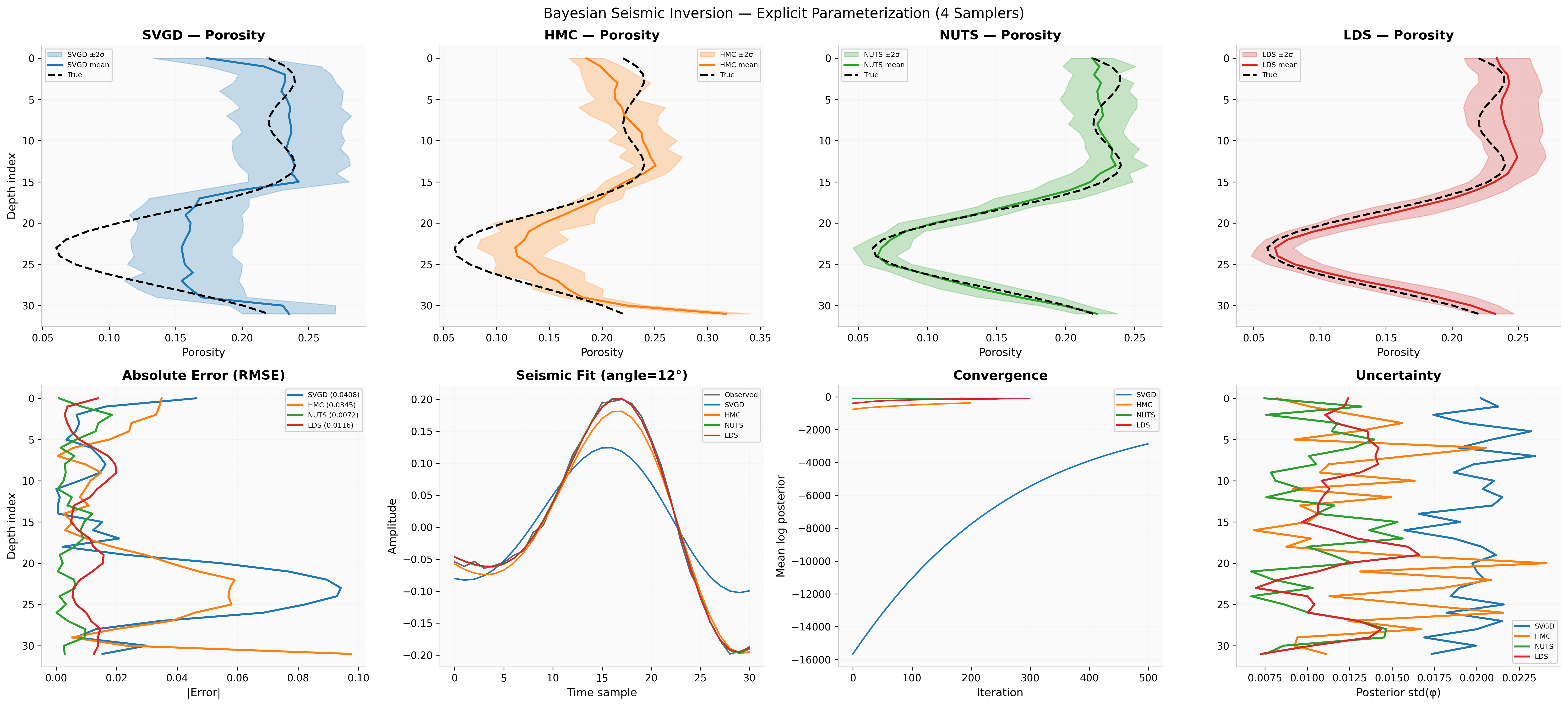
Fig. 6 Bayesian AVO Inversion – Posterior distributions from four gradient-informed samplers (SVGD, HMC, NUTS, LDS) applied to amplitude-versus-offset inversion (Tutorial 13).#
Key Features#
- Differentiable Multiphysics
Seamlessly integrates geostatistics, reservoir simulation, rock physics, and geophysics in a single computational graph. All modules support PyTorch automatic differentiation.
- Bayesian Inference
Four gradient-informed samplers (SVGD, HMC, NUTS, LDS) enable rigorous uncertainty quantification alongside deterministic inversion.
- Deep Learning Integration
Incorporates neural networks for prior modeling (Deep Image Prior), surrogate modeling, latent-space representations, and network-based reparameterizations.
- 70+ Rock Physics Models
Comprehensive library covering effective medium theories, granular media models, fluid substitution, empirical relations, anisotropy, and resistivity.
- Plug-and-Play Architecture
Each physics module is self-contained and composable. Add new physics (resistivity, fluid flow, etc.) without modifying core logic.
- Real-World Applications
Demonstrated on CO\(_2\) storage characterization at the Illinois Basin – Decatur Project (IBDP) and joint seismic–resistivity inversion for the Sleipner CCS site in the Norwegian Sea.
Module Overview#
Module |
Description |
|---|---|
|
Geostatistical simulation (FFT-MA, SGS), co-simulation, generative models (VAE, GAN, Diffusion) |
|
70+ rock physics models: effective medium, granular, fluid substitution, empirical, anisotropy |
|
Seismic wave propagation (acoustic & elastic 2D/3D), AVO, wavelets, boundary conditions |
|
Differentiable reservoir fluid flow simulation (oil-water two-phase) |
|
Deterministic inversion: Inverter with Explicit, Latent, Network parameterizations; L-BFGS, Gauss-Newton |
|
Bayesian samplers (SVGD, HMC, NUTS, LDS), distributions, kernels |
|
Neural network components: Bayesian layers (Flipout), custom activations |
|
SEG-Y, LAS, Eclipse reservoir grid I/O |
|
Publication-quality visualization: seismic sections, fields, well logs, production curves |
|
Data transforms (Normalize, Sigmoid, Logit) and dataset utilities |
|
Decision under uncertainty: Value of Information (VOPI), closed-loop reservoir management |
Tutorials#
GeoBrain ships with 15 tutorials that progress from basic geostatistics
through to real-world Bayesian joint inversion. Each tutorial is available as
both a Python script (examples/*.py) and a Jupyter notebook
(examples/notebooks/*.ipynb), so you can follow along interactively or run
them from the command line.
# |
Topic |
Description |
|---|---|---|
01–02 |
Geomodeling |
FFT-MA simulation, co-simulation, SGS, variograms |
03–04 |
Implicit Modeling |
Differentiable implicit geological modeling, karst cave inversion |
05–06 |
Rock Physics & AVO |
Rock physics workflows, AVO forward modeling |
07–08 |
Wave Propagation |
2D acoustic & elastic FDTD on Marmousi2 |
09 |
Full Waveform Inversion |
Acoustic FWI with automatic differentiation |
10–11 |
Flow Simulation |
Two-phase reservoir flow, dynamic well control |
12 |
Seismic Inversion |
Deterministic inversion (Explicit, Network, Latent) |
13 |
Bayesian Inversion |
Bayesian AVO with 4 samplers (SVGD, HMC, NUTS, LDS) |
14 |
IBDP Case Study |
CO\(_2\) site latent-space SVGD inversion |
15 |
Sleipner Case Study |
Joint seismic–resistivity inversion for CO\(_2\) |
Cite Us#
If you use GeoBrain in your research, please cite:
@software{geobrain2026,
  title  = {GeoBrain: An End-to-End Differentiable Platform
            for Integrated Subsurface Modeling},
  author = {Liu, Mingliang},
  year   = {2026},
  url    = {https://github.com/GeoBrain-Project/geobrain}
}
Please email mingliangliu@sdu.edu.cn for questions or commercial licensing inquiries. For bugs and feature requests, open an issue on GitHub.